
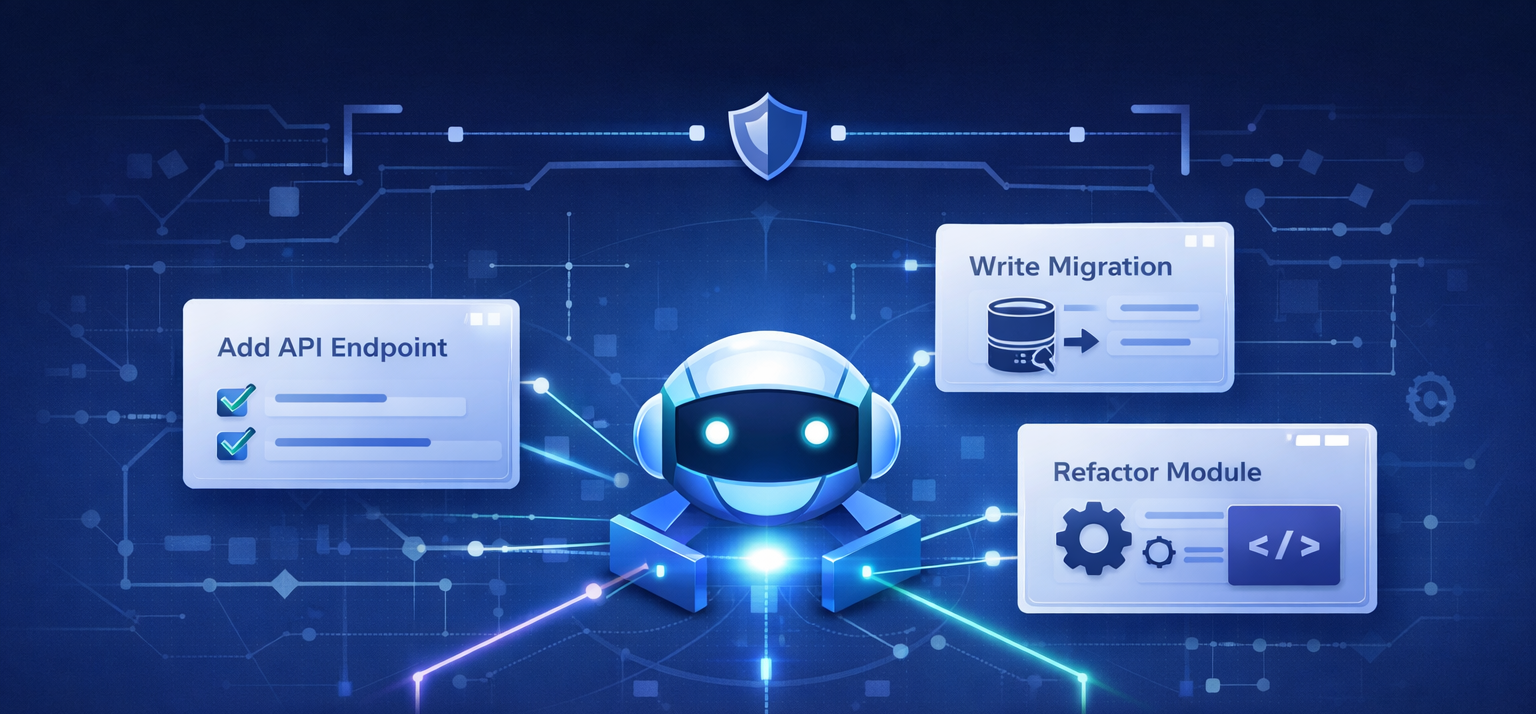
Introducing Skills in Packmind: Governing How AI Coding Agents Execute Work
AI coding agents are becoming increasingly capable at executing tasks. What remains difficult, however, is ensuring that these agents consistently execute work the way a team expects.
This gap is not about code generation quality. It is about how teams capture and share how work is done: the steps, constraints, and expectations that experienced developers apply implicitly every day.
This is where skills come in. Today, we’re introducing native support for skills in Packmind, allowing teams to create, update, distribute, and govern skills across repositories and AI coding agents, using the same mechanisms already available for standards, rules and commands.
What Are Skills?
In practice, most engineering teams already rely on skills, even if they do not explicitly name them as such. A skill represents a repeatable way of performing a task, such as:
adding a new API endpoint
writing or updating a database migration
refactoring a module
creating a test suite
reviewing a pull request
These practices are usually learned through experience and shared informally. They might exist in documentation, Slack conversations, or code review comments. When teams start using AI agents, this implicit knowledge becomes a problem: agents can execute tasks, but they lack the context required to execute them correctly.
Skills make this knowledge explicit and reusable.
Why Skills Break Down Without Governance
Before this release, teams attempting to use skills with AI agents typically faced the same limitations:
Skills are defined in tool-specific formats
They are duplicated across repositories
Updates are applied inconsistently
There is no clear source of truth
Drift accumulates silently as codebases evolve
As a result, agents behave differently depending on the repository or tool being used. Over time, this inconsistency erodes trust and increases review effort.
These failures are not caused by the agents themselves. They come from the absence of a source of truth and governance to manage skills as shared engineering artifacts.
Skills as First-Class Artifacts in Packmind
With this release, skills are now treated as first-class elements of the Packmind engineering playbook.
Teams can:
define skills once and reuse them across projects
update skills in a controlled and traceable way
distribute skills automatically to multiple repositories
make skills available to different AI coding agents through a shared context
apply the same governance mechanisms used for standards, rules and commands.
This ensures that skills remain consistent, up to date, and aligned with the evolving codebase. Skills also help manage context window constraints by design. Because they are self-discoverable and invoked only when relevant, skills follow a progressive disclosure pattern: they are not loaded into the context by default, but pulled in when the task requires them, keeping agent context focused and efficient.
Why Skills Matter for Teams Using AI Agents
As AI agents take on more execution work, the main challenge shifts. The limiting factor is no longer how fast code can be generated, but how reliably recurring tasks are executed in a way that matches the team’s expectations.
Skills sit between high-level standards and raw code generation. They encode how a task should be performed within a specific context. When skills are properly managed, agents stop guessing and start producing output that is predictable and reviewable.
This reduces rework, lowers review overhead, and makes automation sustainable at scale.
Completing the Engineering Playbook
Packmind’s approach to context engineering is structured around three complementary elements:
Standards, which define architectural principles and constraints
Rules, which enforce what must or must not happen
Skills, which encode how recurring tasks are executed
Together, these elements form a living engineering playbook that AI agents can consume consistently across repositories and tools.
Available Today in Packmind Open Source
Skills support is available now in Packmind Open Source. Teams can start by defining a small set of skills in a single repository and progressively expand their playbook as usage grows.
This release is a step toward making AI-assisted development more reliable by focusing on how teams capture, share, and govern context.
AI agents do not need better model.
They need better, more actionable context.